
Financed Like Utilities
Capital, Power, and the New Economics of AI

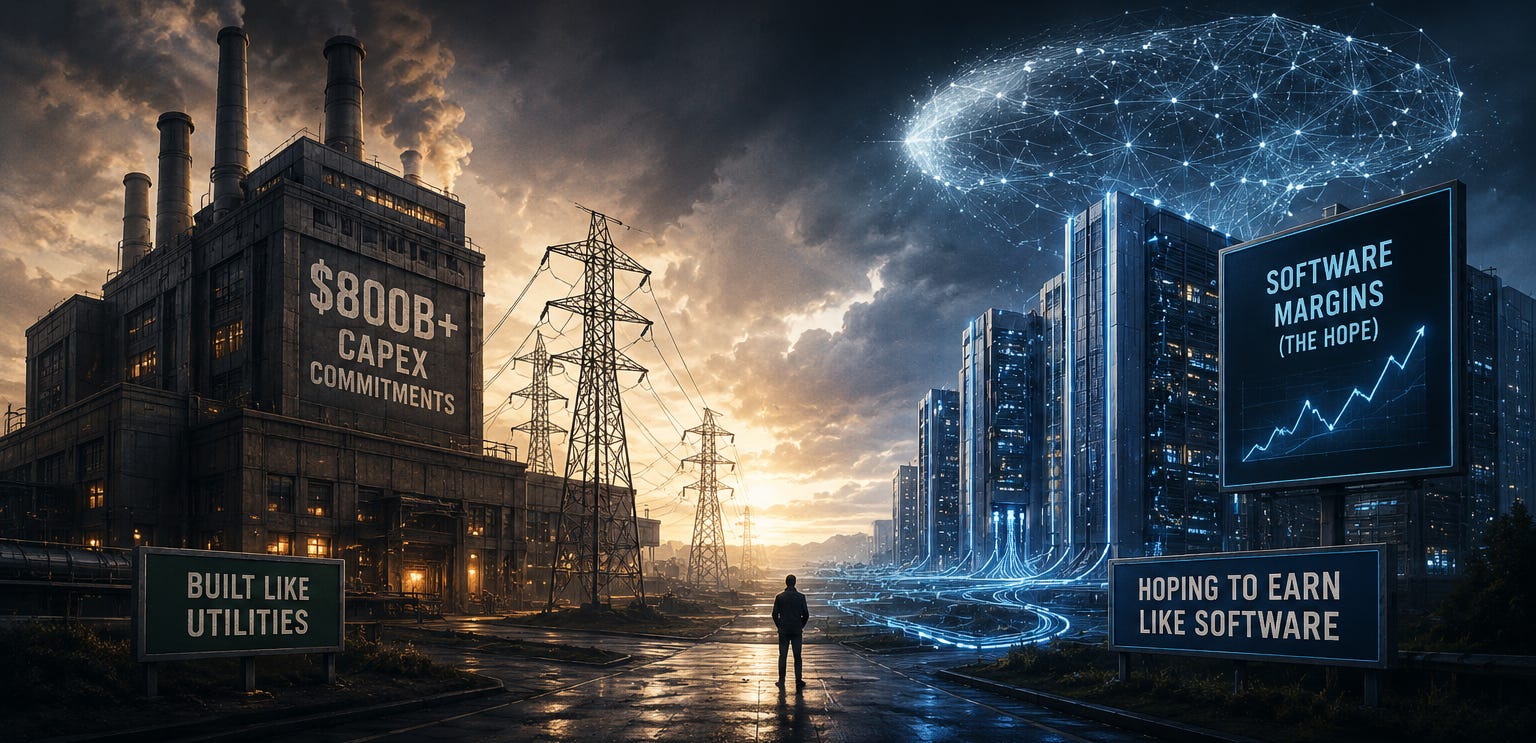
On Friday, 5 June 2026, the Nasdaq Composite closed at 25,709.43, down 4.18 percent, its worst session since the tariff turmoil of April 2025. Nvidia gave up almost five percent. The move invited a familiar interpretation: that investors were reassessing the economics of artificial intelligence. Whether Friday’s selloff reflected that tension or merely rates and positioning is impossible to definitively know.
Several forces moved it at once. A May payroll print of 172,000 against an 80,000 forecast pushed the ten-year Treasury yield above 4.5 percent and the thirty-year past five, and higher long rates fall hardest on companies financing a buildout with borrowed money. Broadcom had declined to raise its AI chip outlook days earlier. Index concentration turned ordinary profit-taking into a four-percent drop. Anyone pinning the whole move on one cause is selling a story.
Underneath the rate noise sits a slower recognition. The companies building frontier AI now finance themselves like utilities while hoping to earn the margins of software. The financing has already changed, and the proof is that the richest firms on earth, the ones with the least need for outside money, are raising it at record scale. Whether the margins follow is the open question the market started asking out loud this week.
The Escape from Software Economics
For two decades, large-cap technology compounded on capital-light economics. Write the code once, serve it at near-zero marginal cost, keep the margin, return the cash. AI has broken that arrangement, and the issuers prove it.
Alphabet is the clearest case, and a filing settles it, not rumor. A prospectus dated 2 June priced its offering at 84.75 billion dollars, the largest equity raise in any industry on record: fifteen billion in mandatory convertible preferred, fifteen billion in common stock, a forty-billion at-the-market program, and a ten-billion private placement to Berkshire Hathaway. The stated purpose was capital expenditure for AI infrastructure and global compute, with demand outstripping current supply. Guidance puts 2026 capex near 190 billion dollars, after it nearly doubled from 52.5 billion in 2024 to 91.4 billion in 2025. Dan Niles of Niles Investment Management said the quiet part: he never expected Google to tap public markets to fund its own spending.
Meta carries the debt-side version. It raised 2026 capex guidance to a ceiling of 145 billion dollars on 29 April and fell as much as 9.5 percent the same day; one day later it sold 25 billion dollars of investment-grade bonds across six tranches, the longest maturing in 2066, against 96 billion in orders. Amazon, Oracle, and the rest of the group issued over 100 billion in bonds across 2025.
Heavy demand admits a gentler reading. The Alphabet book was oversubscribed, Berkshire stepped in, and credit buyers took paper maturing four decades out, all of which marks conviction as much as strain. The fact is that operating cash flow no longer covers the build.
Amazon’s trailing free cash flow fell about 95 percent to roughly 1.2 billion dollars as capex surged near 59 billion against 148.5 billion in operating cash flow. Bank of America estimates that hyperscaler capex now absorbs about 94 percent of operating cash flow after dividends and buybacks, against a ten-year average near 40.
The private labs carry the same signature in sharper form, and here the numbers turn from filings to commitments and estimates.
OpenAI has committed to roughly 1.4 trillion dollars of compute over eight years, a commitment, not cash, on 2025 revenue near 13 billion; it reset its own target in February to about 600 billion by 2030, and HSBC estimates a funding gap above 200 billion by then.
Bloomberg reported Anthropic’s May raise at a 965-billion valuation, ahead of OpenAI. Its widely cited 47-billion figure is an annualized run rate derived from private-market disclosures rather than audited revenue. These are the financing patterns of grids and railroads.
The State at the Cap Table
Capital intensity of this order has pulled the government past the regulator’s chair and into the ownership question, and the role it is taking remains unsettled.
As shareholder, the United States now holds a 9.9 percent stake in Intel, funded by converting 8.9 billion dollars of unpaid CHIPS Act grants into equity at 20.47 a share, which makes Washington the company’s largest holder; in late May it took minority positions in nine quantum-computing firms through a two-billion-dollar program. The Council on Foreign Relations counts about sixteen such federal equity investments since January 2025, near 20.9 billion dollars in total, and Treasury Secretary Bessent has signaled the model could widen to other strategic sectors.
As customer it is already the one that matters most, through procurement, defense contracts, and the Stargate program announced from the White House in January 2025 with emergency permitting attached. As regulator it tightened its grip in June 2026 with an executive order requesting early access to frontier models before release. As coordinator it brokers the permitting, land, and power that no single firm can assemble alone.
The role it has refused is financier of last resort. When OpenAI’s chief financial officer floated a federal guarantee for AI infrastructure loans in November 2025, she retracted it within days, Altman wrote that the company wanted no guarantees for its data centers, and administration officials told Bloomberg the idea was off the table. What OpenAI has sought instead is narrower: an extension of the 35 percent manufacturing tax credit to cover grid components and data centers, a subsidy, not a backstop. The relationship even runs adversarial in places, with the Pentagon tagging Anthropic a supply-chain risk and Anthropic suing to reverse it.
Five roles, then, and no settled answer on which one governs. A state that owns the equity, buys the output, writes the rules, builds the connective infrastructure, and declines to guarantee the debt is no longer the regulator of a private industry. It is a partner in a strategic one. The market has yet to price that partnership, because nobody yet knows its terms.
Financed Like a Utility, Hoping for Software
Frontier AI now carries the cost structure of infrastructure. AI data-center capex reached about 1.2 percent of US GDP in 2025 by the Investment Research Partners estimate, above the early-2000s telecom buildout near one percent and below only the 1880s railroad boom near six. Cumulative hyperscaler AI capex from 2024 through 2029 tracks toward 2.5 to three trillion dollars, larger than Canada’s economy.
The historical rhyme carries a warning. Builders of era-defining infrastructure rarely capture the value they create: the panics of 1873 and 1893 bankrupted hundreds of railroads, and the telecom bust destroyed some two trillion dollars with fiber utilization near three percent. Liaquat Ahamed, who chronicled the bankers of the Depression and has written a history of the 1870s railroad mania, said in June that the AI spending boom terrifies him.
The infrastructure frame ends at the balance sheet. AI keeps what utilities never had: network effects, data moats, application-layer differentiation, and four live ways to charge, through ads, cloud, enterprise seats, and consumer subscriptions. Let inference cost fall fast enough and those channels throw off software margins on utility assets.
Not all of it needs industrial scale either, since specialized models run on one server and edge models run on a phone. So the sharper description is the one the financing alone cannot settle: these firms fund themselves like utilities while underwriting the hope that they earn like software. The capex is utility-shaped today. The returns remain a wager.
China’s Different Game, Without the Caricature
America concentrates capital to build the largest clusters it can. China works the opposite side of the equation, driving the unit cost of intelligence toward zero and pushing it everywhere. The US-China Economic and Security Review Commission drew the contrast in March, US compute-intensive frontier models against Chinese open development and rapid deployment.
That split is a tendency, not a wall. Both countries pursue both ends. US hyperscalers chase efficiency through custom silicon and distillation; China chases frontier capability under sanctions on advanced chips. Cheap power helps Beijing, while reliability, model quality, and talent still constrain it.
DeepSeek released V4 on 24 April, a 1.6-trillion-parameter mixture-of-experts model that activates 49 billion parameters per token and prices its Flash tier near fourteen cents per million input tokens, by various comparisons an order of magnitude or more below leading US models. V4 runs on Huawei’s Ascend silicon, and Huawei’s roadmap is a bid for independence from Nvidia: the CloudMatrix system already rivals Nvidia’s flagship at the rack level, at roughly four times the power draw that cheap domestic electricity makes affordable, with successive Ascend generations promised through 2028.
Domestic chips reached about 41 percent of China’s market in 2025, against an Nvidia share once above 90. Even Washington’s 2026 decision to allow H200 sales into China at a 25 percent fee met official Chinese discouragement in favor of domestic parts.
Should the cost of intelligence fall faster than frontier capability rises, value migrates from the few model creators toward operators and large-scale deployers, the layer China is optimizing. That thesis was first priced in January 2025, when the original DeepSeek release sent Nvidia down seventeen percent and erased 589 billion dollars in a single session, the largest one-day loss in the history of US equities, by Bloomberg’s count.
Electricity into Tokens
Every serious cluster turns electricity into tokens, and electricity has become the scarce input. The IEA projects global data-center power consumption above 1,000 terawatt-hours in 2026, near Japan’s national total, roughly doubling by 2030 in its base case; US data centers could draw twelve percent of national electricity by then, up from about four.
The grid binds harder than the chips now. Interconnection queues in mature US and European hubs run seven to ten years, transformer lead times reach 128 weeks, and the IEA expects nearly a fifth of planned projects to slip. Satya Nadella has described chips sitting idle for want of power to plug them in.
The sequence from researchers to balance sheets to grids runs with heavy overlap. Power binds today, while algorithmic efficiency, small modular reactors, geothermal, and behind-the-meter generation push back. A constraint that partly relieves itself does not end the build; it reprices the map.
Capital follows firm power. SoftBank has pledged up to 75 billion euros for five gigawatts of AI capacity in France, a ceiling, not a contract, though the first phase, 45 billion euros for 3.1 gigawatts in Hauts-de-France by 2031 with EDF and Schneider Electric, is firm. Masayoshi Son told La Tribune that France being a producer and exporter of energy was absolutely decisive.
France draws about 68 percent of its power from nuclear, ran a record net export balance of 92 terawatt-hours in 2025, and sells industrial electricity well below British prices, while SoftBank’s Ohio site must build some 33 billion dollars of dedicated gas generation to light a comparable campus.
The French deal anchored a record Choose France summit on 1 June, where Macron announced 93 billion euros in foreign-investment pledges, the data-center program about half of it.
Argentina is the same calculation at the frontier. A letter of intent signed in October 2025 commits OpenAI and Sur Energy to a Patagonian site of up to 500 megawatts and up to 25 billion dollars, structured under the country’s large-investment incentive regime, drawing on Vaca Muerta gas, Patagonian wind, cheap land, and light regulation.
The pledges deserve a discount. France’s headline figures, SoftBank’s ceiling, and Stargate’s totals are announced commitments, not money spent, and French commentators flagged that some 2025 projects had not broken ground a year on. Read them as intent, and watch the concrete.
The Small Hill
Masayoshi Son holds the longest view of anyone signing the cheques. He tells interviewers that AI could run fifty times larger than the internet and that the next trillion-dollar company will come out of robotics. His reading of the dot-com crash is the part worth sitting with: the peak of 2000, he says, was a small hill, after which the market fell and then climbed far higher on real cash flow and real growth, and AI sits at the same early point with the profit still ahead. The claim bets on the second derivative, that capability and monetization compound past the cost of the build before the financing gives way.
His own analogy supplies the counterweight, though not in the way he intends. The historical reconciliation between the panic of 1873 and the “small hill” of 2000 is that technological revolutions routinely bankrupt their first generation of underwriters. The railroad overbuild of the 1870s and the telecom bust of the 2000s did not fail as technologies; they failed as capital structures. The infrastructure survived while ownership transferred to later buyers at a fraction of the original cost.
The question for AI is not whether capabilities compound, but whether today’s cap tables survive long enough to harvest the value they create.
What the Tape Is Pricing
Strip the rate noise and the market is auditing the cash flows it took on trust for three years. Three gaps draw the scrutiny.
Spend against revenue: Morgan Stanley estimates 2026 hyperscaler capex near 805 billion dollars against AI software revenue most put between 100 and 150 billion, with OpenAI’s 1.4 trillion in commitments resting on 13 billion in revenue.
Reflexivity in the financing: Nvidia has committed up to 100 billion dollars to OpenAI, which buys Nvidia chips; OpenAI signed a roughly 300-billion deal with Oracle, which buys Nvidia chips; Nvidia holds stakes in CoreWeave and xAI. Analysts size the loop above 800 billion and reach for the dot-com vendor-financing comparison. It only half fits. The loop concentrates in the model labs and the neoclouds, where Lucent and WorldCom once sat, while the hyperscalers feeding it carry Search, AWS, and enterprise cloud underneath, profit engines that can fund a decade of AI losses without a default. Five-year default-swap spreads on Oracle and Microsoft have still roughly doubled since September, which says the credit market has begun to separate the layers.
Return on the spend: the MIT Media Lab found about five percent of integrated enterprise pilots extracting real value on 30 to 40 billion dollars of spending, and an NBER survey of some 6,000 executives in February found about 90 percent reporting no employment effect and 89 percent no productivity change over three years.
The case against the easy bubble call is that the revenue is real.
Meta grew above 33 percent, largely through its advertising engine.
Google Cloud’s backlog runs past 460 billion dollars, a measure of contracted demand rather than realized earnings.
AWS grew 28 percent.
Anthropic’s widely cited 47-billion figure represents an annualized run rate rather than realized audited revenue.
The unwind also has a gentle path: the same efficiency that compresses token prices could shrink the capex itself, so that small and edge models carry more of the load and the 805-billion forecast deflates on its own, a markdown, not a rupture.
Every era-defining boom ran similar concentration and similar capex before it matured, and the firms underwriting this one hold the strongest balance sheets on earth.
The technology is not hollow. The claim is narrower and harder to dismiss: spending has outrun the path to cash, the financing has turned reflexive, and the cheapest intelligence may arrive on someone else’s chips.
Whether Friday’s selloff reflected this tension or simply higher rates remains unknowable. The tension itself remains.
The firms financed like utilities now have to prove they can earn like software. Capital concentrates. Cost compresses. The current decides who keeps playing.
Son calls it a small hill. The tape has started to price the climb
.